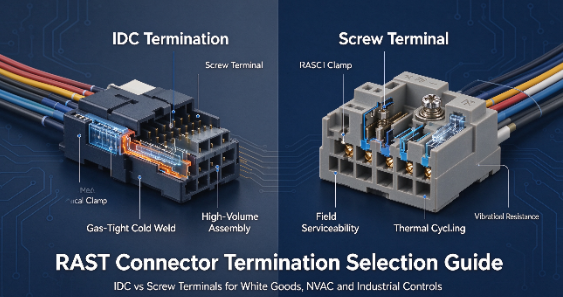
In high-volume manufacturing for white goods, HVAC systems, and industrial controls, connection reliability dictates system lifecycle performance. The integrity of a wire-to-board or wire-to-wire connection is paramount. Selecting the wrong method for attaching wires leads to severe production issues. You might face assembly bottlenecks and excessive tooling overhead on the factory floor. Alternatively, you could experience vibration-induced failures and expensive field maintenance post-deployment. This guide provides a technical evaluation of insulation displacement connectors and screw terminals. We compare their mechanical properties, assembly scalability, and long-term reliability. Engineering teams can use this data to specify the optimal connector termination method for their exact application requirements.
Automation vs. Manual Assembly: RAST IDC Connectors enable high-speed, automated harness production by eliminating wire stripping and crimping, whereas RAST screw terminals require manual wire preparation and precise torque application.
Vibration and Environmental Resistance: IDC terminations create a gas-tight, cold-welded joint highly resistant to vibration, while screw terminals are susceptible to loosening under thermal cycling and mechanical shock without proper mitigation.
Wiring Configurations and Cable Types: IDC excels in flat cable, ribbon cable, and complex run/tap configurations, whereas screw terminals offer superior flexibility for discrete wires and varied cross-sections.
Field Serviceability: Screw terminals allow for rapid field repairs and accept a wider variance of wire gauges, making them ideal for low-volume, highly customized, or maintenance-heavy applications.
What the RAST Standard Means for Wire Connections
RAST (Raster Anschluss Steck Technik) is a connector standard widely used in household appliances to improve connection reliability, prevent mismating, and simplify automated assembly. RAST 2.5 features a 2.5mm pitch for compact signal and low-current circuits, while RAST 5.0 uses a 5.0mm pitch for higher-current applications such as motors and heating elements. Selecting the correct connector requires evaluating current ratings, wire gauge compatibility, mechanical retention, and environmental conditions.
Key Factors in RAST Wire Connection Selection
Factor | Selection Consideration |
Current Rating | Match connector capacity to electrical loads |
Wire Gauge | Verify supported conductor sizes |
Mechanical Strength | Ensure reliable wire retention |
Environmental Resistance | Consider temperature, moisture, and vibration |
Termination Method | Balance assembly efficiency and maintenance needs |
RAST IDC Connectors: Mechanics and Application Realities
RAST IDC Connectors use insulation displacement technology to connect wires without removing their insulation. This method supports fast, consistent termination and is particularly suitable for automated wire harness manufacturing.
How RAST IDC Connectors Work
IDC terminals feature specially designed metal slots that displace wire insulation and establish electrical contact with the conductor. Proper insertion force and compatible wire specifications help create stable, low-resistance connections without separate stripping or crimping operations.
Key Advantages of RAST IDC Connectors
Advantage | Benefit |
No Wire Stripping | Reduces preparation steps |
Automated Termination | Improves production efficiency |
Consistent Connections | Reduces manual assembly variations |
Compact Design | Supports space-efficient harness layouts |
Daisy-Chaining | Enables compatible loop-through wiring configurations |
Limitations and Design Considerations
RAST IDC connectors require precise compatibility between terminal geometry, wire gauge, insulation thickness, and conductor construction. Incorrect wire selection or insertion depth can compromise electrical reliability. IDC termination may also require specialized equipment, and damaged connections often need replacement rather than reuse.
Typical Applications
RAST IDC connectors are commonly used in washing machines, refrigerators, HVAC systems, lighting equipment, and appliance control boards. They are particularly useful for high-volume production where efficient wire termination, compact wiring, and consistent assembly quality are priorities.
Key Takeaway: RAST IDC connectors are well suited for automated manufacturing, offering efficient termination and dependable connections when wire specifications and installation processes are properly controlled.
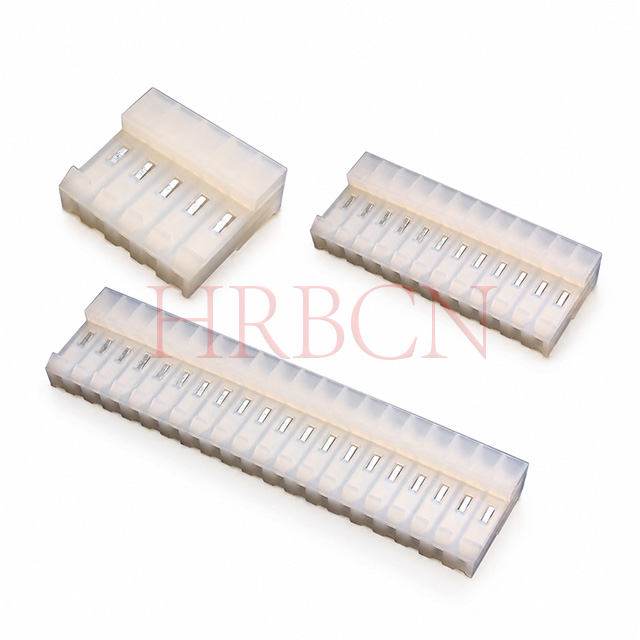
RAST Screw Terminals: Mechanics and Application Realities
RAST screw terminals use mechanical clamping to secure electrical wires, offering flexible installation and reliable power connections. Their performance depends on proper wire preparation, tightening torque, and operating conditions.
How RAST Screw Terminals Work
Screw terminals secure stripped conductors using a threaded screw or cage-clamp mechanism. Proper tightening creates stable electrical contact while preventing loose connections and excessive resistance. Following manufacturer-specified torque values helps avoid wire damage and overheating.
Key Advantages of RAST Screw Terminals
Advantage | Benefit |
Wire Compatibility | Supports different wire types and sizes within rated limits |
Easy Installation | Uses common installation tools |
Field Maintenance | Allows convenient wire replacement and inspection |
Secure Connection | Provides reliable mechanical retention |
Power Handling | Supports higher-current applications when appropriately rated |
Limitations and Design Considerations
RAST screw terminals require more manual assembly than IDC connectors because wires must be stripped, inserted, and tightened individually. Improper torque, vibration, and thermal cycling may reduce connection reliability over time. Using calibrated tools and following installation guidelines helps minimize these risks.
Typical Applications
RAST screw terminals or compatible screw-clamp terminal designs can be used in industrial control panels, HVAC equipment, lighting systems, and power distribution assemblies where flexible wiring and field maintenance are important.
Key Takeaway: Screw terminals offer installation flexibility and easy maintenance, while IDC connectors are generally better suited for automated, high-volume wire harness production.
IDC vs Screw Terminal: Side-by-Side Comparison
1. Assembly Scalability and Throughput
RAST IDC connectors support fast, automated wire termination without stripping insulation, making them ideal for high-volume manufacturing. Screw terminals require individual wire preparation, insertion, and tightening, increasing assembly time. Although IDC systems require higher initial tooling investment, they can significantly reduce labor costs and improve production consistency at scale.
2. Mechanical Reliability and Environmental Tolerance
IDC connections maintain consistent contact pressure and can provide reliable performance under vibration and thermal cycling when properly terminated. Screw terminals depend on mechanical clamping force, which may decrease due to improper tightening, vibration, or temperature changes. Both technologies can deliver dependable connections when correctly specified, installed, and maintained.
3. Wire Gauge Flexibility and Standardization
IDC connectors require compatible wire gauges, conductor types, and insulation materials to ensure proper termination. Screw terminals generally accommodate a wider range of wire sizes within their specified ratings, offering greater installation flexibility. Selecting the correct wire dimensions and following manufacturer specifications helps prevent loose connections, overheating, and premature failure.
4. Field Maintenance and Lifecycle Support
Screw terminals are convenient for field maintenance because technicians can disconnect, inspect, and reconnect wires using standard tools. IDC connectors are better suited for factory-assembled harnesses but may require specialized tools or replacement terminals during repairs. The best choice depends on maintenance frequency, accessibility, and long-term service requirements.
| Performance Metric | RAST IDC Connectors | RAST Screw Terminals |
| Assembly Throughput | Extremely high; supports fully automated processing. | Low to moderate; requires manual stripping and torquing. |
| Vibration Tolerance | Superior; gas-tight cold weld prevents loosening. | Vulnerable; screws can back out without threadlockers. |
| Wire Preparation Required | None; blade pierces directly through insulation. | Extensive; requires stripping, twisting, and ferrule crimping. |
| Field Serviceability | Complex; requires specialized insertion tools or harness replacement. | Simple; requires only a standard flathead or Phillips screwdriver. |
| Wire Type Flexibility | Rigid; strict tolerances for insulation hardness and stranding. | High; accepts varied gauges, solid/stranded, and any insulation. |
| Thermal Cycling Resistance | Excellent; spring-like blade maintains constant contact pressure. | Moderate; susceptible to wire creep and tension loss over time. |
Quick Reference: Connector Termination Decision Matrix
High-Volume / High-Vibration / Automated: RAST IDC Connectors.
Low-Volume / High-Mix / Field-Service Heavy: RAST Screw Terminals.
Complex Run/Tap or Ribbon Cable Routing: RAST IDC Connectors.
Variable Wire Gauges / Heavy Cross-Sections: RAST Screw Terminals.
Conclusion
Audit your current wire harness production lines to identify bottlenecks in stripping and crimping stations.
Request physical termination samples from connector manufacturers to evaluate mating forces and housing durability.
Perform accelerated thermal cycling and mechanical vibration testing on prototype harnesses using both termination methods.
Implement calibrated torque-limiting drivers on all manual assembly stations to prevent strand damage.
Establish strict wire procurement guidelines to ensure insulation hardness matches your automated insertion tooling specifications.
FAQ
Q: What is the primary difference between a RAST IDC connector and a RAST screw terminal?
A: The primary difference lies in the connection mechanism. IDC uses a sharp metal blade to pierce the wire insulation and displace it, creating a cold weld with the conductor in a single step. A screw terminal requires stripping the wire and uses a threaded screw to mechanically clamp the bare copper, requiring a multi-step manual assembly process.
Q: Can RAST IDC connectors be reused or re-terminated?
A: While technically possible in highly limited scenarios, it is strongly discouraged. The internal metal blades deform slightly during the first insertion to create the gas-tight seal. Reusing the slot compromises this precise geometry, leading to a loss of gas-tight reliability and increased electrical resistance.
Q: Do I need special tools to install RAST IDC Connectors?
A: Yes. Mass production requires automated pneumatic or electric presses to terminate multiple wires simultaneously. For field repairs or low-volume prototyping, you must use specific IDC hand tools. These tools ensure the wire is pushed to the exact required depth without damaging the plastic housing.
Q: Are screw terminals better for high-current applications?
A: Screw terminals can often accommodate larger maximum wire cross-sections. This allows them to support heavier gauge wires needed for higher current ratings. However, their ability to handle high current safely depends entirely on applying the exact specified torque to minimize contact resistance.
Q: How does vibration affect connector termination choice?
A: IDC is vastly superior for high-vibration environments. The cold-welded, gas-tight joint remains secure under constant mechanical shock. Screw terminals are vulnerable to vibration; the screws can slowly back out over time unless secured with chemical threadlockers or specialized tensioning designs.
Q: What cable and wire types are compatible with IDC vs. screw terminations?
A: IDC requires strict adherence to specific insulation hardness and is ideal for flat, ribbon, and modular cables. Screw terminals are much more forgiving. They accept varying discrete wire types, insulation materials, and gauges, provided they meet the terminal block's minimum and maximum cross-section limits.


