Electrical system failures and arc faults frequently originate at a single point of vulnerability: improperly specified or exposed wire terminations. Engineers and installers must balance rapid assembly requirements with strict safety compliance, environmental protection, and the prevention of accidental short circuits in high-density panels. Selecting the correct Fully insulated terminal requires moving beyond basic wire gauge matching to evaluate insulation materials, terminal geometry, internal barrel anatomy, and tooling compatibility for long-term reliability. High-vibration environments, moisture exposure, and dense component packaging demand termination solutions that eliminate the risk of incidental contact while maintaining optimal conductivity. We will break down the structural differences between various insulated connectors so you can build robust, touch-safe electrical systems that withstand rigorous operational demands.
Strict AWG Color-Coding: Industry-standard color codes (Red, Blue, Yellow) dictate precise wire gauge compatibility; mismatching leads to mechanical pull-out or excessive contact resistance.
Material Dictates Environment: The choice between PVC, Nylon, and Heat Shrink insulation determines the terminal's thermal tolerance, chemical resistance, and environmental sealing capabilities.
Tooling is Critical: Utilizing generic or non-ratcheting crimpers on fully insulated terminals frequently compromises the insulation jacket, voiding safety certifications and exposing conductive elements.
Touch-Safe Compliance: Fully insulated designs are non-negotiable in high-vibration, high-density applications where adjacent conductive components pose a short-circuit risk.
Field-Ready Performance: Pre-insulated terminals drastically reduce installation time in field repairs compared to bare terminals requiring secondary heat-shrink application.
How Fully Insulated Terminals Work
Problem Framing (Success Criteria)
Modern electrical panels often contain many relays, contactors, and terminal blocks in limited space, increasing the risk of accidental short circuits. Terminals may also be exposed to vibration, moisture, salt, and temperature changes in industrial, marine, and automotive applications. A reliable terminal should provide secure wire retention, good insulation, moisture protection, and a compact design suitable for high-density wiring.
Anatomy of a Reliable Connection
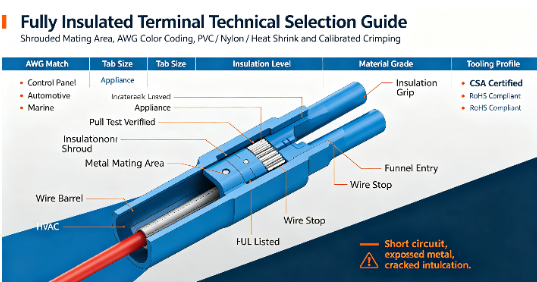
Understanding the internal structure of a Fully Insulated Terminal is critical for specifying the correct component for high-reliability applications. The visible plastic jacket hides highly engineered metal components designed for specific mechanical tasks. Installers must recognize how these internal features interact with the copper conductor during the crimping process.
The Barrel: The metal cylinder where the wire is inserted and crimped. Barrels feature either a butted seam or a brazed seam. Butted seams consist of metal rolled into a tube, which can split open under aggressive crimping pressure. Brazed seams fuse the metal edges together, creating a solid cylinder that withstands heavy crimping forces without deforming or opening, ensuring superior wire retention.
Funnel Entry Design: High-quality terminals incorporate an internal taper within the insulation sleeve. This funnel guides fine wire strands directly into the barrel. Without a funnel entry, individual copper strands often fold back against the insulation during insertion. Folded strands reduce the total conductive mass inside the crimp, increasing electrical resistance and creating localized hot spots.
The Shroud: The defining feature of fully insulated designs. The shroud extends past the metal mating surface, completely enveloping the connection point after mating. This protective layer ensures no live metal remains exposed, providing a touch-safe environment critical for maintenance personnel and system integrity.
Wire Stop: An internal physical barrier that prevents the wire from being pushed too far through the barrel. Over-insertion interferes with the mating mechanism and compromises the mechanical integrity of the crimp.
Overall Value and Trade-offs
Selecting the appropriate terminal type requires weighing component cost against installation time, safety requirements, and environmental durability. Each terminal configuration offers distinct advantages depending on the application context. Field technicians often default to the cheapest option, but engineering specifications must dictate the exact terminal style based on the operational environment.
| Terminal Type | Structural Design | Primary Advantages | Primary Disadvantages |
| Fully Insulated | Complete dielectric shroud covering the entire metal mating area. | Maximum touch-safe protection, prevents accidental shorts in dense panels, eliminates secondary insulation steps. | Larger physical footprint, higher unit cost, hides the crimp from visual inspection. |
| Partially Insulated | Insulation covers the crimp barrel but leaves the mating tab/ring exposed. | Lower cost, easier visual verification of wire insertion, fits into standard terminal blocks. | Leaves live metal exposed to incidental contact, unsuitable for high-density relay connections. |
| Bare Terminals | No factory-applied insulation; solid metal construction. | Lowest unit cost, highest temperature tolerance, allows for highly aggressive crimping profiles. | Requires manual application of heat shrink or electrical tape for safety, drastically increasing labor time. |
Types of Fully Insulated Terminals
Fully Insulated Quick Disconnects (Fastons)
Quick disconnects, frequently referred to as Fastons, consist of completely shrouded male tabs and female receptacles. These terminals facilitate rapid connection and disconnection without requiring tools. The full insulation ensures that when the male tab slides into the female receptacle, the overlapping plastic shrouds create a continuous dielectric barrier. Technicians rely on these connectors for relays, microswitches, contactors, and modular power supplies. Applications requiring frequent maintenance, component swapping, or modular assembly benefit heavily from fully insulated quick disconnects because they protect personnel from live circuits during hot-swapping procedures. When wiring a 24V DC control panel, installers use these disconnects to terminate limit switch inputs and solenoid valve outputs, allowing for rapid troubleshooting without exposing adjacent terminals to short circuits.
Fully Insulated Flag Terminals
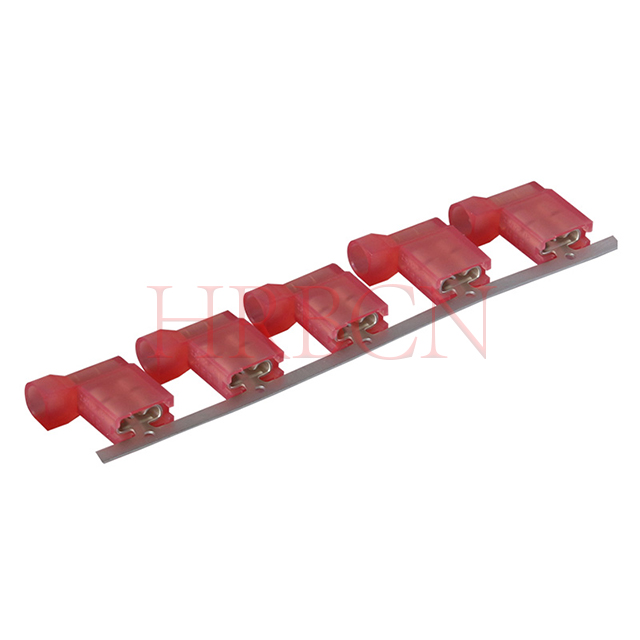
Flag terminals feature a 90-degree right-angle design where the female quick disconnect sits perpendicular to the wire axis. The full insulation jacket covers the entire right-angle assembly. Engineers specify flag terminals in severely space-constrained environments where a standard straight terminal would force the wire to bend sharply against an enclosure wall. Sharp bends induce mechanical strain on the copper strands, eventually leading to metal fatigue and wire breakage. Flag terminals route the wire parallel to the mating surface immediately upon connection. You will find these extensively in appliance motors, tight control panels, and compact automotive switchgear. For example, when wiring the compressor capacitor in an HVAC unit, the clearance between the capacitor terminals and the access panel often requires flag terminals to prevent the wires from being crushed when the panel is secured.
Fully Insulated Ring and Spade Terminals
Ring terminals use a closed-loop design that provides a secure connection and is suitable for grounding and high-vibration applications. Spade terminals use an open-fork design, allowing faster installation because the mounting screw only needs to be loosened rather than removed. Fully insulated versions help protect the crimp area and reduce the risk of accidental contact or short circuits in control panels, machinery, and automotive wiring.
Fully Insulated Butt Splices and Bullet Connectors
Butt splices and bullet connectors are commonly used for inline wire connections. Butt splices permanently join two wires end-to-end, while bullet connectors use male and female parts that can be disconnected when needed. Fully insulated versions help protect the connection from accidental contact and are widely used in wire harnesses, automotive repairs, and industrial control wiring.
Fully Insulated Pin and Receptacle Terminals
Pin terminals feature a solid, needle-like metal extension designed to insert into specialized sockets or compression-style terminal blocks. Receptacle terminals provide the matching socket. The fully insulated shroud protects the base of the pin and the entire receptacle. These terminals dominate high-density European-style terminal blocks and specific Printed Circuit Board (PCB) interface connections. The rigid pin prevents delicate stranded wire from fraying or breaking when compressed by the set screw in a terminal block. The insulation ensures that tightly packed pins do not touch each other where they enter the block housing. In programmable logic controller (PLC) installations, installers use pin terminals to terminate fine-stranded I/O wiring, ensuring a clean, secure connection into the narrow screw terminals of the PLC modules.
Fully Insulated Terminal Sizes and AWG Color Codes
The Industry Standard Color Matrix
Electrical standards mandate a strict color-coding system for insulated terminals based on American Wire Gauge (AWG) sizes. This universal matrix ensures installers instantly identify the correct terminal for the wire at hand, preventing catastrophic mechanical failures. Mismatching wire gauge to terminal size results in either a loose connection that pulls out under tension or an over-stuffed barrel that fails to crimp properly. Field technicians must memorize this color matrix to maintain assembly speed and accuracy.
| Insulation Color | AWG Range | Cross-Sectional Area (mm²) | Typical Applications |
| Red | 22–18 AWG | 0.5–1.5 mm² | Low-current control circuits, sensor wiring, basic instrumentation lines, PLC inputs. |
| Blue | 16–14 AWG | 1.5–2.5 mm² | General-purpose lighting, automotive accessories, standard 15-amp industrial control circuits. |
| Yellow | 12–10 AWG | 4.0–6.0 mm² | High-current applications, primary power feeds, heavy motor loads, main grounding lines. |
Evaluating Wire Strand Count vs. Terminal Barrel Capacity
Matching the AWG color code is important, but wire construction should also be considered. Wires with the same AWG size can have different strand counts and may require different barrel sizes. Flexible, high-strand-count wires need enough space to enter the terminal without bending or spreading the strands. A smooth funnel entry can help guide the wire into the barrel and improve crimp quality. Always check that the terminal barrel is suitable for both the wire gauge and wire type before crimping.
PVC vs. Nylon vs. Heat Shrink Insulation
PVC (Polyvinyl Chloride)
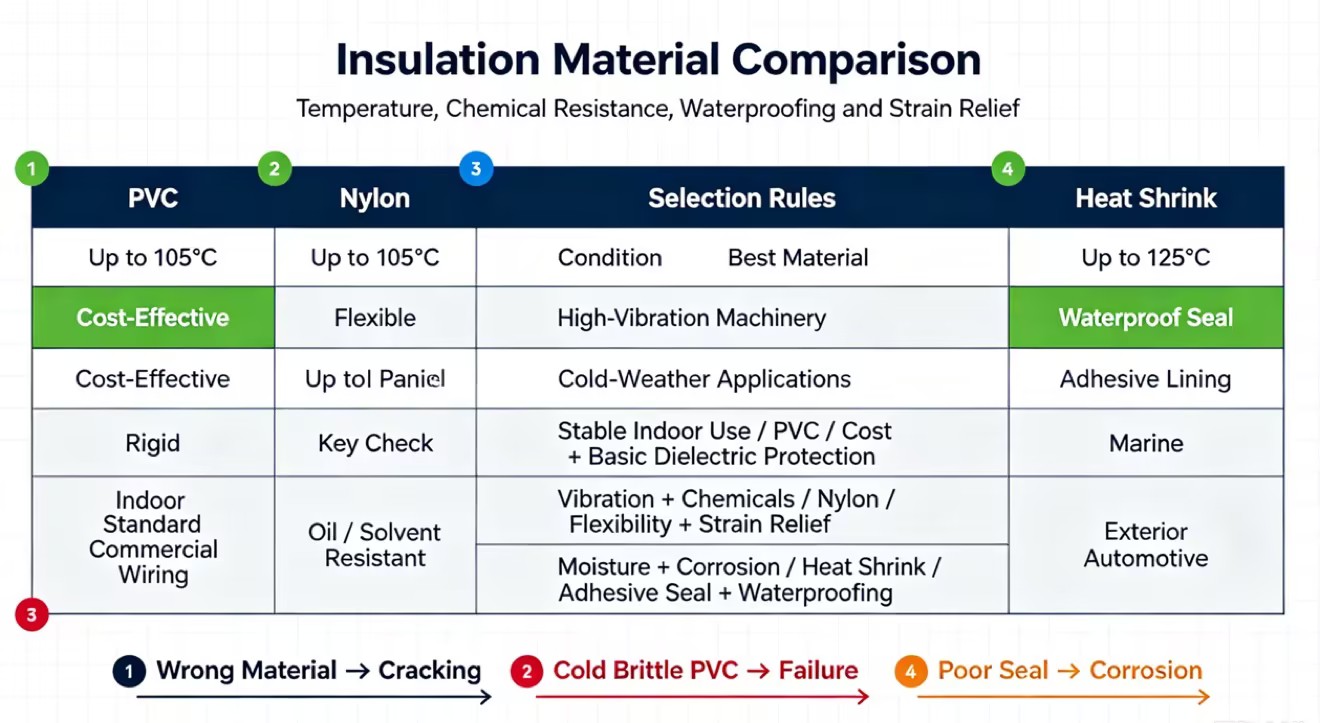
PVC is a cost-effective insulation material commonly used for indoor control panels and standard electrical wiring. It provides good protection under normal operating conditions and supports standard terminal color coding. However, PVC may become brittle in very cold temperatures and can be affected by some chemicals. For outdoor, high-temperature, or chemically exposed environments, nylon or other more durable insulation materials may be more suitable.
Nylon (Polyamide)
Nylon insulation offers better flexibility, temperature resistance, and resistance to oils and chemicals than standard PVC. Its translucent design can also make it easier to check wire positioning before crimping. Many nylon terminals support double crimping to secure both the conductor and wire insulation, providing better strain relief. These features make nylon terminals suitable for automotive, heavy machinery, and other high-vibration or harsh environments.
Heat Shrink with Adhesive Lining
Heat shrink terminals provide strong protection against moisture, salt, and chemicals. When heated, the outer insulation shrinks around the wire while the internal adhesive creates a sealed connection and provides additional strain relief. This makes heat shrink terminals suitable for marine, outdoor automotive, and other applications where wiring is regularly exposed to water or harsh environments.
| Insulation Material | Flexibility | Temperature Rating | Environmental Resistance |
| PVC | Low (Rigid) | Up to 105°C | Basic dust and incidental contact. Poor chemical resistance. |
| Nylon | High | Up to 105°C (Better cold weather performance) | Resists oils, solvents, and hydraulic fluids. Excellent strain relief. |
| Heat Shrink | Medium (Rigid once cured) | Up to 125°C | 100% waterproof, seals out salt and corrosion. Maximum strain relief. |
Conclusion
Audit all current assembly tooling on the production floor to guarantee absolute compatibility with insulated terminal crimp profiles, removing any piercing-style dies.
Request and review manufacturer specification sheets for all incoming terminals to verify thermal limits, dielectric ratings, and UL/CSA certifications.
Standardize inventory storage bins by strict AWG color codes to physically prevent technicians from mismatching wire gauges and terminal sizes during rapid assembly.
Implement mandatory pull-testing protocols for the first article of any new wire harness run to validate mechanical integrity before mass production begins.
FAQ
Q: What is the difference between a fully insulated terminal and a partially insulated terminal?
A: A fully insulated terminal features a plastic shroud that completely covers the metal mating area, preventing any accidental contact with live metal after connection. A partially insulated terminal only covers the crimp barrel, leaving the metal tab, ring, or pin exposed to potential short circuits.
Q: What is a funnel entry on a fully insulated terminal?
A: A funnel entry is an internal taper inside the terminal's plastic sleeve. It acts as a guide to funnel all fine wire strands smoothly into the metal barrel. This prevents strands from folding back, ensuring maximum conductivity and preventing weak crimps.
Q: Can I use a standard bare-wire crimping tool on a fully insulated terminal?
A: No. Bare-wire crimpers use piercing dies designed to puncture metal. Using these on an insulated terminal will slice through the plastic jacket, destroying the insulation, exposing live wire, and voiding the safety rating. You must use an oval or asymmetrical die designed for insulated terminals.
Q: Why does the insulation split or crack when I crimp the terminal?
A: Insulation cracks for three main reasons: using the wrong crimp tool (like a piercing die), crimping a terminal in freezing temperatures (which makes PVC brittle), or trying to force a wire gauge that is too large into an undersized terminal barrel.
Q: How do I choose between nylon and PVC fully insulated terminals?
A: Choose PVC for standard, cost-effective indoor applications where temperatures remain stable. Choose nylon for high-vibration environments, exposure to chemicals or solvents, or cold-weather applications, as nylon is highly flexible, resists cracking, and often provides better mechanical strain relief.
Q: Are standard fully insulated terminals waterproof?
A: No. Standard PVC and nylon fully insulated terminals protect against accidental contact and dust, but they do not seal out water. For waterproof connections, you must use heat shrink terminals with an internal adhesive lining that melts and seals the connection.


