| Availability: | |
|---|---|
| Quantity: | |
M2050-N-C(90°)
HRB
8536909000
M2050-N-C(90°)
① ② ③④⑤
①M2050: HRB series
②N: Number of pins: 2-24
③C: Housing color, see below chart explanation
④Without R(Blank): Without polarizing tabs
⑤90°: Closed End
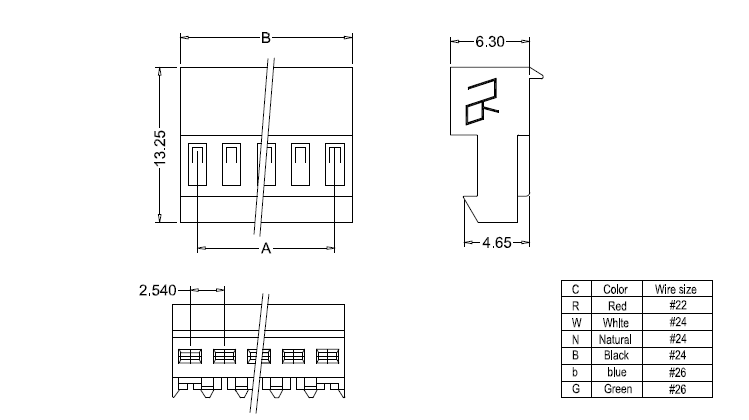
| C | Housing color | Wire size |
| R | Red | AWG22 |
| W | White | AWG24 |
| N | Natural | AWG24 |
| B | Black | AWG24 |
| b | blue | AWG26 |
| G | Green | AWG26 |

| Part No. | Dimensions | Part No. | Dimensions | ||||
| UL94V-2 | Circuits | Dim: A | Dim: B | UL94V-2 | Circuits | Dim: A | Dim: B |
| M2050-2-C(90°) | 2 | 2.54 | 5.08 | M2050-10-C(90°) | 10 | 22.86 | 25.40 |
| M2050-3-C(90°) | 3 | 5.08 | 7.62 | M2050-11-C(90°) | 11 | 25.40 | 27.94 |
| M2050-4-C(90°) | 4 | 7.62 | 10.16 | M2050-12-C(90°) | 12 | 27.94 | 30.48 |
| M2050-5-C(90°) | 5 | 10.16 | 12.70 | M2050-13-C(90°) | 13 | 30.48 | 33.02 |
| M2050-6-C(90°) | 6 | 12.70 | 15.24 | M2050-14-C(90°) | 14 | 33.02 | 35.56 |
| M2050-7-C(90°) | 7 | 15.24 | 17.78 | M2050-15-C(90°) | 15 | 35.56 | 38.10 |
| M2050-8-C(90°) | 8 | 17.78 | 20.32 | M2050-16-C(90°) | 16 | 38.10 | 40.64 |
| M2050-9-C(90°) | 9 | 20.32 | 22.86 | M2050-17-C(90°) | 17 | 40.64 | 43.18 |
Key Features
No polarizing tabs offers greater mating flexibility.
IDC termination allows quick, solder-free assembly.
Positive alignment improves connection reliability.
Reduces risk of mismatching during installation.
Compatible with standard 2.54 IDC connector systems.
Robust housing provides secure cable retention.
UL94V-2 flame retardant housing, RoHS compliant
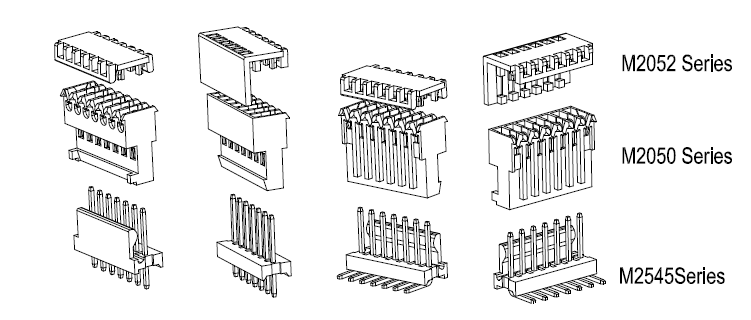
Designed to pair with M2052R series housing covers, effectively preventing dust, moisture and foreign debris from damaging exposed contact terminals.
M2050-N-C(90°): Indirect PCB mating; mates with M2545 and M2545R series PCB headers to achieve reliable wire-to-board interconnection.

Q1: What wire sizes are supported by 2.54 IDC connectors?
A: Typically supports 22–26 AWG, depending on the specific part number.
Q2: Is soldering required for termination?
A: No. IDC technology provides a solder-free wire termination process.
Q3: What is the function of the closed end IDC design?
A: The closed-end IDC prevents wire strands from slipping out, avoids short circuits, improves connection reliability, and also provides better protection against dust and accidental contact.
Q4: What are the design implications of using 2.54 IDC closed end without polarizing tabs?
① The absence of polarizing tabs offers greater mating flexibility.
② The closed-end IDC structure enhances wire retention and prevents conductor strand extrusion, reducing the risk of short circuits
and improving connection safety and reliability.
③ The simplified housing design reduces mould complexity and manufacturing cost, while also easing dimensional tolerance
requirements compared with polarized versions.
④ Additional orientation-identification measures are required, such as pin-1 markings, cable color coding, or PCB silkscreen
indicators, to ensure correct assembly and maintenance.
Q5: Are special tools required for assembly?
A: Hand tools or bench termination tools are recommended for consistent wire insertion.
Q6: What applications are these connectors commonly used in?
A: Industrial controls, appliances, instrumentation, and low-voltage electronic systems.
Procurement FAQs
Q1: What are the main benefits of IDC connectors compared to crimp solutions?
A: Faster assembly, fewer components, and reduced labor costs.
Q2: Are closed end IDC without polarized tabs versions available in multiple circuit counts?
A: Yes. Various positions and configurations are available to meet different design requirements.
Q3: Can these connectors help reduce assembly time?
A: Yes. IDC termination enables rapid mass termination without wire stripping.
Q4: Are polarized versions interchangeable with standard 2.54 IDC connectors?
A: They are designed for compatibility within the 2.54 IDC system while adding mating protection.
Q5: What factors should be considered when selecting a connector?
A: Circuit count, wire gauge, polarization requirements, and application environment.
Q6: Are these connectors suitable for high-volume production?
A: Yes. Their simple termination process supports efficient large-scale manufacturing.
1. Point-to-point wiring in electronics
Internal wiring of circuit boards in industrial or consumer equipment.
Example: connecting a control board to sensors or switches.
2. Industrial control and automation
PLCs (Programmable Logic Controllers) and I/O modules.
The polarizing tab ensures correct orientation in high-density panels.
3. Test equipment and prototyping
Quick, reversible connections to PCBs without soldering.
Often used in labs where boards are frequently swapped.
4. Computer and peripheral internal wiring
Legacy PC components and embedded systems.
Short ribbon cables to headers on daughterboards or connectors.
5. Point-of-sale or kiosk devices
Connecting displays, buttons, and small peripherals internally.
Polarizing tabs prevent field service mistakes.
6. Small appliances and electronics
Consumer devices that require fast, reliable internal wiring.
Vibration-resistant thanks to IDC design.