Introduction
In the world of electronics and industrial equipment, ensuring devices are protected against dust and water is crucial. Ingress Protection (IP) ratings define how resistant a device is to these environmental factors. In this article, we will explore the differences between IP67 connectors and IP68 connectors, helping you understand which one best suits your needs.
What is an IP Rating?
Definition of IP Rating
An IP rating, or Ingress Protection rating, is a standardized classification that determines the level of protection provided by an enclosure against foreign objects and liquids. The rating is composed of two digits: the first digit indicates protection against solid particles like dust and dirt, while the second digit refers to the protection against liquids, primarily water.
The IP rating system is defined by the International Electrotechnical Commission (IEC) under the standard IEC 60529, and it helps users understand the level of environmental protection their devices have, making it easier to choose the right product for specific conditions.
How IP Ratings Work
The first digit in an IP rating represents the degree of protection against solid objects. It can range from 0 (no protection) to 6 (complete protection against dust). The second digit, which focuses on water protection, ranges from 0 (no protection) to 9K (high pressure and high-temperature water jets).
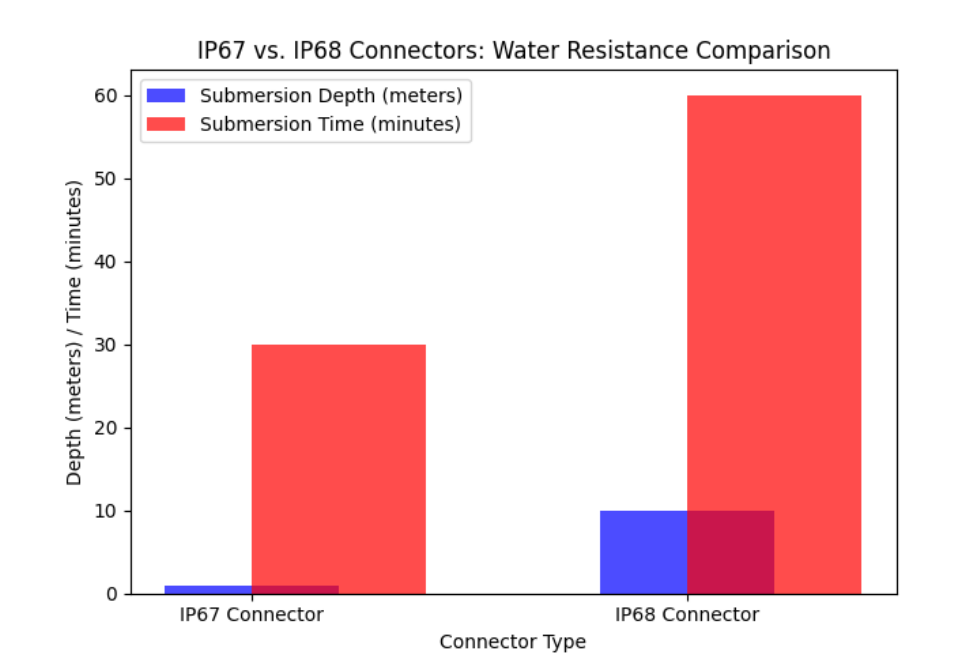
For example, in the case of IP67 connectors, the “6” means they are dust-tight, while the “7” means they can handle immersion in water up to 1 meter for 30 minutes. Similarly, an IP68 connector offers a higher level of protection against water submersion, typically beyond 1 meter and for longer durations, as specified by the manufacturer.
IP67 vs. IP68 Connectors: Key Differences
Water Resistance and Immersion Depth
The main difference between IP67 connectors and IP68 connectors lies in their water resistance capabilities. IP67 connectors are designed to withstand immersion in water up to 1 meter deep for 30 minutes, making them suitable for environments where temporary water exposure is possible, such as rain or accidental splashes. However, they are not designed for prolonged exposure to water beyond these limits.
On the other hand, IP68 connectors are built to withstand continuous submersion in water, typically at depths beyond 1 meter. The exact depth and duration of immersion are determined by the manufacturer. This makes IP68 connectors ideal for applications like underwater equipment, where devices may be exposed to water for extended periods.
Durability and Testing Standards
Both IP67 and IP68 connectors are tested under standardized conditions to verify their water resistance. For IP67, the test involves immersion in water up to 1 meter deep for 30 minutes, while IP68 connectors are subjected to more stringent testing, which often includes submersion for longer durations and greater depths. As a result, IP68 connectors tend to have more advanced sealing systems and materials, making them more durable in harsh environments.
Cost and Application Suitability
Due to the more advanced sealing technology and testing requirements, IP68 connectors are generally more expensive than IP67 connectors. However, the additional cost is often justified in applications where water exposure is prolonged or extreme, such as marine, underwater, or deep-sea environments.
IP67 connectors are often used in less demanding situations, where short-term water exposure is a concern, making them a cost-effective option for outdoor electronics, security systems, and industrial sensors.
Feature | IP67 Connectors | IP68 Connectors |
Water Protection | Temporary immersion up to 1 meter for 30 minutes | Continuous immersion beyond 1 meter |
Dust Protection | Complete dust protection (Level 6) | Complete dust protection (Level 6) |
Cost | More affordable than IP68 | Generally more expensive due to advanced sealing |
Common Uses | Outdoor lighting, rain-exposed electronics | Underwater cameras, submersible pumps |
Real-World Use Cases of IP67 and IP68 Connectors
IP67 Connectors
IP67 connectors are widely used in applications where devices may be exposed to occasional water splashes or temporary immersion. They are commonly found in outdoor environments where the equipment may encounter rain, such as in outdoor lighting, security cameras, and automotive sensors.
For instance, IP67 connectors are ideal for garden lights, which might be exposed to rain or sprinklers but will not be submerged in water for long. Similarly, IP67 is a popular rating for electronic devices like smartphones, which may occasionally be exposed to water but are not designed for extended underwater use.
IP68 Connectors
IP68 connectors are used in applications where devices are likely to face continuous submersion in water or need to operate in wet conditions for extended periods. Examples include underwater cameras, submersible pumps, and marine-grade electronics, all of which require continuous water resistance to function properly in environments such as oceans, lakes, or rivers.
The IP68 connectors are also used in deep-sea equipment and underwater robotics, where the devices are exposed to more demanding conditions, such as deeper water depths and longer immersion times.
Application Type | IP67 Connectors | IP68 Connectors |
Outdoor Electronics | Garden lighting, security systems | Underwater cameras, marine equipment |
Industrial Sensors | Exposed to rain or temporary water | Submersible pumps, deep-sea equipment |
Automotive Components | Sensors exposed to rain or washing | Marine-grade electronics for continuous submersion |
When to Choose IP67 and When to Choose IP68
Choosing IP67
IP67 connectors are best suited for applications where water exposure is occasional and brief. If your device is expected to be exposed to rain, splashes, or temporary submersion, but not for long durations or greater depths, IP67 connectors will be sufficient.
Examples of these applications include:
● Outdoor security cameras exposed to rain.
● Garden lighting systems that might get splashed or watered.
● Industrial sensors in environments with occasional wet conditions.
Choosing IP68
IP68 connectors should be chosen for environments where devices will be submerged for extended periods or exposed to high water pressure. If your device will be continuously underwater or if it operates in conditions with high water exposure, IP68 connectors will provide the necessary protection.
Applications requiring IP68 connectors include:
● Underwater sensors or cameras used in marine research.
● Submersible pumps in lakes or oceans.
● Devices used in deep-sea exploration or underwater construction.
How to Maintain IP67 and IP68 Connectors
Maintenance for IP67
While IP67 connectors offer robust protection, they still require regular maintenance to ensure their effectiveness. Over time, seals and gaskets can degrade due to exposure to harsh conditions or prolonged use. It is essential to inspect the connectors periodically for any signs of wear or damage, especially after being exposed to water or dust.
Routine maintenance involves cleaning the connectors and checking for any signs of corrosion or cracks in the seals. If necessary, replace damaged seals to maintain the waterproof integrity of the connector.
Maintenance for IP68
IP68 connectors generally require more advanced care due to their continuous exposure to harsh environments. Regular maintenance should include checking for any wear on seals and gaskets, as well as ensuring that the connectors remain free from debris or blockages. Depending on the conditions, connectors may need to be tested and resealed periodically to ensure their continued performance.
In extreme environments, such as those involving high water pressure or temperature fluctuations, it is crucial to perform additional checks to maintain the connectors' durability.
Maintenance Aspect | IP67 Connectors | IP68 Connectors |
Seals and Gaskets | Regular inspection and cleaning | Advanced care and re-certification after harsh conditions |
Common Issues | Degradation from prolonged exposure or improper installation | Checking for wear and tear, ensuring continuous protection |
Expected Lifespan | 5-7 years for regular use | 10+ years, especially in submerged applications |
Conclusion
In summary, both IP67 connectors and IP68 connectors provide excellent protection against water and dust. However, they serve different purposes depending on the level of exposure. IP67 connectors are ideal for brief or shallow water exposure, like outdoor lighting or electronics exposed to rain. In contrast, IP68 connectors offer superior protection for applications requiring prolonged submersion, such as underwater cameras or submersible pumps. By understanding the differences, you can choose the right solution for your needs. Shenzhen Haiyuncheng Electronic Co., Ltd. offers a range of high-quality connectors, ensuring reliable performance in challenging environments.
FAQ
Q: What is the main difference between IP67 and IP68 connectors?
A: The main difference is the depth and duration of water protection. IP67 connectors provide temporary water immersion protection up to 1 meter for 30 minutes, while IP68 connectors can withstand continuous submersion beyond 1 meter.
Q: Can IP67 connectors be used in underwater applications?
A: IP67 connectors are suitable for temporary underwater use up to 1 meter depth for 30 minutes. For extended or deeper immersion, IP68 connectors are recommended.
Q: Are IP67 connectors suitable for outdoor environments?
A: Yes, IP67 connectors are ideal for outdoor applications exposed to rain or brief water immersion, such as in outdoor lighting or security systems.
Q: Why are IP68 connectors more expensive than IP67?
A: IP68 connectors are more expensive due to advanced sealing systems, designed for continuous submersion in water beyond 1 meter, making them suitable for more extreme conditions.
Q: How do I choose between IP67 and IP68 connectors for my project?
A: Choose IP67 connectors for applications with occasional water exposure. For longer submersion or harsher conditions, IP68 connectors are more appropriate for reliability.


