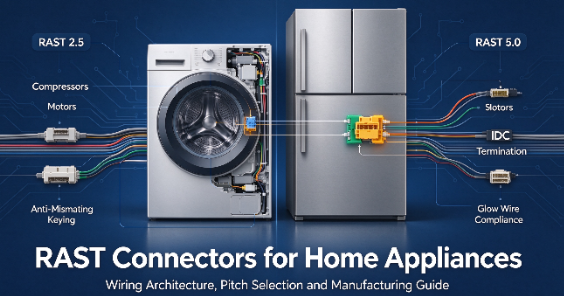
The increasing complexity of electronic controls in modern home appliances requires wiring systems that guarantee zero-defect manufacturing and long-term reliability. Appliance manufacturers face high costs associated with manual assembly errors, harness failures due to vibration or thermal cycling, and stringent global safety compliance requirements. Mismating a single connection on a fast-paced assembly line leads to equipment failure, costly rework, or dangerous electrical faults in the field.
To solve these engineering and production bottlenecks, the industry relies on the RAST (Raster Anschluss Steck Technik) standard. This standardized framework operates as the backbone of modern appliance wiring. By integrating standardized pitch dimensions, physical keying, direct and indirect mating options, and highly efficient termination methods, RAST systems eliminate guesswork on the factory floor. Engineers design safe power and signal architectures while production teams benefit from automated harness manufacturing and foolproof assembly processes.
Key Takeaways
Standardized Assembly: RAST connectors utilize physical keying, polarization (poka-yoke), and standardized color-coding to eliminate mismating errors during high-speed appliance assembly.
Application-Specific Pitch: RAST 2.5 (2.5mm pitch) is optimized for sensors and low-current PCB connections, while RAST 5.0 (5.0mm pitch) handles high-current power delivery for motors and compressors.
Manufacturing Efficiency: Compatibility with automated Insulation Displacement Contact (IDC) termination significantly reduces wire harness production time compared to traditional crimping and enables efficient daisy-chain wiring.
Architectural Flexibility: The choice between direct mating (edge card) and indirect mating (via headers) allows engineers to balance PCB costs against mechanical retention requirements.
Regulatory Compliance: Specifying RAST connectors that meet IEC 60335-1 (Glow Wire Test) and utilize halogen-free materials is mandatory for mitigating fire risks in unattended white goods.
RAST Connectors: Core Wiring Solution for Home Appliances
The transition from discrete wiring to standardized harnesses marks a massive shift in appliance manufacturing. Historically, assembly lines relied on disparate, proprietary terminal blocks, wire nuts, and individual spade terminals. This legacy approach required intensive manual labor. Assembly workers had to read complex wiring diagrams and manually route individual wires to specific terminals. This introduced high risks of cross-wiring and inconsistent termination quality. Driven initially by the European appliance industry's push for automation, the RAST standard emerged to unify connection topologies.
By establishing a common dimensional and mating framework, manufacturers now utilize fully automated harness processing machines. These machines cut, strip, and terminate thousands of wires per hour with exact precision. This drastically reduces cycle times and removes human error from the wire preparation phase.
Selecting the right white goods connectors requires meeting strict baseline engineering criteria. The connection must withstand severe mechanical vibration generated by motors and pumps over a lifespan of ten to fifteen years. The materials must tolerate extreme thermal cycling, from the sub-zero environment of a freezer to the high ambient heat near a compressor. Modern control boards demand space-saving form factors without compromising high dielectric strength, ensuring safe isolation between low-voltage logic circuits and high-voltage mains power.
Adopting a universal standard fundamentally improves manufacturing economics. Standardized housings and terminals reduce inventory complexity across multiple product lines. Procurement teams multi-source components from various compliant manufacturers without forcing engineering teams to redesign printed circuit boards (PCBs). Standardized tooling for wire termination lowers capital expenditure across global assembly facilities, ensuring consistent quality whether the harness is built in Europe, Asia, or the Americas.
| Feature | Legacy Discrete Wiring | RAST Standardized Wiring |
| Assembly Method | Manual routing and individual terminal insertion | Automated harness processing and block insertion |
| Error Prevention | Relies on worker training and visual diagrams | Physical keying and color-coding (Poka-Yoke) |
| Termination Speed | Slow, single-wire crimping | High-speed mass termination via IDC |
| PCB Integration | Requires individual spade headers | Direct edge-card mating or multi-position headers |
| Inventory Management | High part count (various terminals, housings) | Consolidated part count (standardized families) |
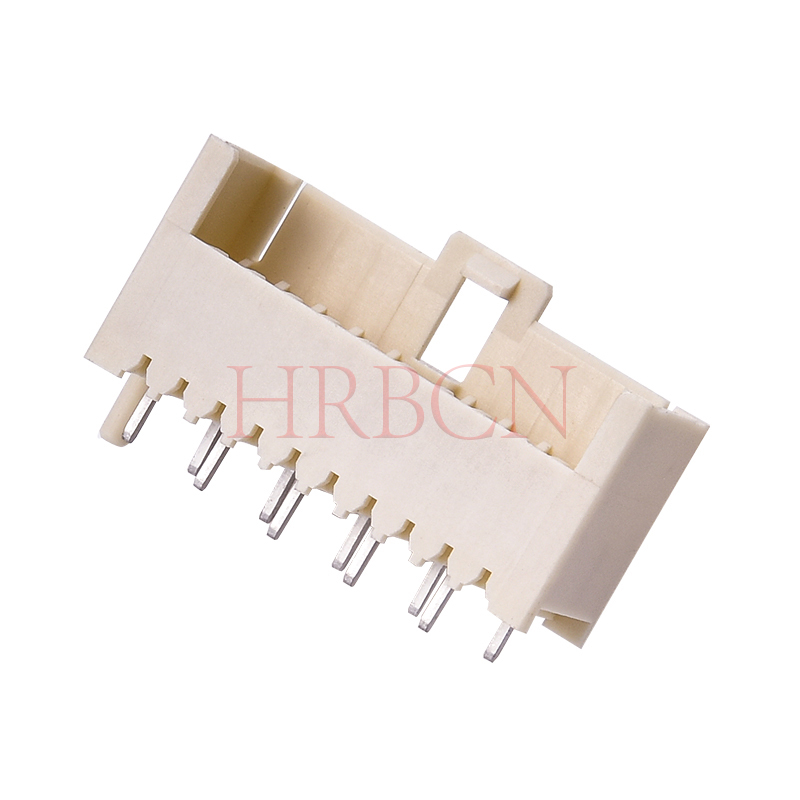
RAST 2.5 vs. RAST 5.0: Selecting the Right Pitch for White Goods
Choosing between RAST 2.5 and RAST 5.0 connectors depends on electrical load, available PCB space, and appliance requirements. RAST 2.5 is generally suited for compact signal connections, while RAST 5.0 supports higher-current power applications in household appliances.
RAST 2.5: Sensor and Low-Power Applications
RAST 2.5 connectors feature a 2.5mm pitch and are commonly used for low-current signals and control circuits. They are suitable for refrigerator temperature sensors, washing machine pressure switches, and appliance display panels. Their compact design saves PCB space and supports high-density wiring, with current ratings depending on the specific connector series.
RAST 5.0: Power Delivery and High-Current Loads
RAST 5.0 connectors use a 5.0mm pitch and typically support higher current ratings, with some models rated up to 16A under specified conditions. They are widely used in washing machine motors, refrigerator compressors, heating elements, and pumps. Their larger terminal design supports reliable power transmission and mechanical stability.
Creepage, Clearance, and Pitch Variations
Creepage and clearance distances are essential for preventing electrical faults in high-voltage appliance circuits. RAST 5.0 connectors offer greater spacing between contacts, while selected configurations use omitted contact positions to achieve larger effective spacing, such as 7.5mm or 10mm. Engineers must verify insulation distances, voltage ratings, and applicable safety standards.
Quick Comparison: RAST 2.5 vs. RAST 5.0
Feature | RAST 2.5 | RAST 5.0 |
Pitch | 2.5mm | 5.0mm |
Current Capacity | Lower-current applications | Higher-current applications |
PCB Space | Compact | Larger footprint |
Typical Applications | Sensors, displays, controls | Motors, heaters, pumps |
Main Advantage | Space-saving design | Greater power-handling capability |
Key Takeaway: Use RAST 2.5 for compact signal and control connections and RAST 5.0 for higher-current appliance circuits, provided the selected connector meets the required electrical, mechanical, and safety specifications.
Decision Framework: Current, Voltage, and Space Constraints
To simplify the selection process between the two primary RAST standards, engineering teams evaluate specific electrical and mechanical parameters.
| Specification | RAST 2.5 | RAST 5.0 |
| Pitch (Centerline) | 2.5mm | 5.0mm (Customizable to 7.5mm / 10.0mm) |
| Maximum Current Rating | Up to 4A | Up to 16A |
| Typical Wire Gauge (AWG) | 22 AWG - 24 AWG | 14 AWG - 20 AWG |
| Dielectric Withstanding Voltage | Moderate (Signal Level) | High (Mains Power Isolation) |
| Primary Application Focus | Sensors, Data, User Interfaces, LEDs | Motors, Compressors, Heaters, Pumps |
RAST Connector Selection for Washing Machines
Washing machines present one of the most hostile operating environments for electromechanical components. The internal wiring harness must survive a decade of violent movement, chemical exposure, and rapid temperature fluctuations.
Vibration Resistance in High-RPM Spin Cycles
Modern front-loading washing machines frequently exceed 1400 RPM during the final spin cycle. This generates intense mechanical oscillation throughout the chassis. The drum acts as a massive unbalanced load, causing the wiring harness to whip and vibrate continuously. If a connector lacks sufficient retention force, this vibration causes contact fretting.
Fretting involves microscopic movements that wear away the protective tin or gold plating on the terminals. This exposes the underlying base metal, which oxidizes rapidly. Oxidation increases electrical resistance, generating heat and eventually causing the connection to fail. To combat this, a high-quality RAST connector features robust locking mechanisms. Internal locking latches secure the terminal within the housing. External friction locks or active latches anchor the connector to the PCB header or edge card. These features ensure the connection remains gas-tight and electrically stable regardless of drum imbalance.
Moisture and Chemical Exposure Mitigation
RAST connectors used in washing machines must withstand humidity, detergent vapors, and chemical exposure. Moisture-resistant housing materials such as properly specified PA66 help maintain mechanical strength and connector stability. Engineers should verify material compatibility, operating conditions, and corrosion resistance to ensure reliable long-term performance.
Motor and Pump Wiring Configurations
RAST 5.0 connectors are commonly used for washing machine motors, drain pumps, and other higher-current connections. Their larger pitch supports suitable power terminals and robust wire harness designs. Indirect mating with PCB-mounted headers can improve mechanical stability, reduce solder joint stress, and maintain reliable electrical connections under vibration.
Daisy-Chaining Sensor Networks
IDC RAST connectors can simplify washing machine sensor wiring by supporting compatible loop-through or daisy-chain configurations. This approach reduces wiring complexity, harness weight, and assembly costs for temperature, speed, and water-level sensors. Proper termination design ensures reliable connections and efficient automated production.
RAST Connector Selection for Refrigerators
Refrigerator connectors must support reliable electrical connections under continuous operation, temperature fluctuations, condensation, and limited installation space. Choosing between RAST 2.5 and RAST 5.0 depends on power requirements, environmental conditions, and PCB layout.
Thermal Cycling and Condensation Challenges
Refrigerator connectors must withstand temperature changes, low-temperature operation, and condensation. Suitable housing materials and corrosion-resistant contacts help prevent cracking, oxidation, and connection failures. Engineers should verify operating temperature ratings and moisture resistance for reliable performance in freezer compartments and compressor areas.
Compressor and Defrost Heater Power Routing
RAST 5.0 connectors are often suitable for refrigerator compressors, defrost heaters, and other higher-current circuits. Their larger terminals can support greater power demands when properly rated. Engineers must verify current capacity, startup loads, contact resistance, and operating temperatures to prevent overheating and ensure stable power delivery.
High-Density PCB Connections for Smart Displays
RAST 2.5 connectors provide compact connections for refrigerator displays, sensors, LED lighting, and low-voltage control circuits. Their smaller pitch helps reduce PCB space and wiring bulk, making them suitable for confined areas such as door assemblies. Proper connector selection supports efficient signal transmission and simplified harness routing.
Main Check Items for Engineers and Purchasing Teams
Selecting the right RAST connector system requires balancing electrical performance, mechanical compatibility, safety compliance, and manufacturing costs. Engineers and purchasing teams should verify the following factors before finalizing connector specifications.
Direct vs. Indirect Mating Architectures
Direct mating RAST connectors connect to PCB edge contacts, eliminating separate headers and reducing component costs. Indirect mating connectors use dedicated PCB-mounted headers for greater installation flexibility and mechanical support. Selection depends on PCB thickness, layout constraints, vibration requirements, and assembly methods.
Keying, Polarization, and Color-Coding (Poka-Yoke Assembly)
RAST connectors use mechanical keying, polarization, and optional color-coding to reduce incorrect connections during assembly. Matching ribs, slots, and housing designs help prevent incompatible mating, while color identification simplifies harness installation. These features improve production efficiency and reduce wiring errors.
Glow Wire Test (GWT) and IEC 60335-1 Compliance
RAST connectors for household appliances must meet applicable electrical safety and flammability requirements. Depending on the application, housing materials may require UL 94 V-0 ratings and glow-wire performance verification under relevant IEC standards. Engineers should confirm material certifications and test results to support safe operation.
IDC vs. Crimp Termination
IDC termination connects insulated wires directly without a separate stripping process, supporting fast, automated harness assembly. Crimp termination uses mechanically compressed terminals and offers flexibility for different wire sizes and connection requirements. IDC is often efficient for high-volume appliance production, while crimping remains suitable for applications requiring specific mechanical or electrical characteristics.
Conclusion
To move forward with optimizing your appliance wiring architecture, execute the following steps:
Audit current harness assembly lines to identify manual bottlenecks, crimping failures, and recurring cross-wiring errors.
Request sample kits from suppliers to perform physical fit-checks and evaluate direct mating tolerances on existing PCBs.
Consult with connector engineering teams to map out a standardized keying and color-coding strategy that prevents vendor lock-in.
Calculate the ROI of transitioning from crimped terminals to automated IDC harness manufacturing based on annual production volume.
Verify that all selected housing materials meet IEC 60335-1 Glow Wire Test requirements for unattended appliances.
FAQ
Q: What does RAST stand for in connectors?
A: RAST stands for Raster Anschluss Steck Technik, which translates from German to "Pitch Connection Plug Technology." It originated in the European appliance industry as a standardized system to unify terminal blocks, enabling automated wire harness manufacturing and eliminating manual assembly errors.
Q: What is the difference between RAST 2.5 and RAST 5.0?
A: The primary difference is the pin pitch and current capacity. RAST 2.5 features a 2.5mm spacing and is designed for low-current signal routing up to 4A, like sensors. RAST 5.0 has a 5.0mm spacing, designed for high-current power delivery up to 16A for motors and compressors.
Q: What is the difference between direct and indirect mating in RAST connectors?
A: Direct mating allows the connector to plug directly onto the edge of a printed circuit board, saving the cost of an additional component. Indirect mating requires the connector to plug into a dedicated header that is soldered to the PCB, providing superior mechanical stability.
Q: Are RAST connectors compatible with IDC termination?
A: Yes, they are highly compatible with Insulation Displacement Contact (IDC) technology. IDC allows automated machinery to press unstripped wires directly into the terminal, creating a fast, gas-tight connection and enabling efficient daisy-chain wiring for sensor networks.
Q: Why are RAST connectors preferred for white goods?
A: They are preferred because their physical keying and color-coding completely prevent cross-wiring during assembly. They are optimized for automated harness manufacturing, withstand high vibration, and meet the strict flammability standards required for household appliances.
Q: What is the Glow Wire Test requirement for appliance wiring?
A: The Glow Wire Test (GWT) is a safety requirement under the IEC 60335-1 standard. It ensures that the plastic housing of the connector is flame-retardant and will self-extinguish if an electrical fault causes the terminal to overheat, preventing fires in unattended appliances.


