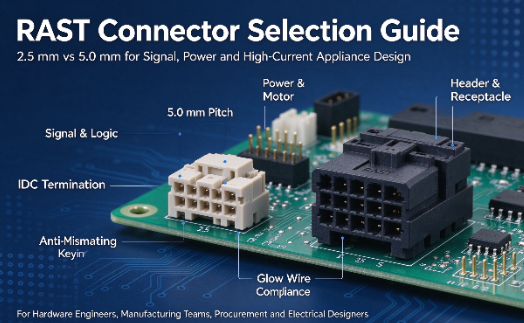
Balancing shrinking printed circuit board (PCB) real estate with the need for reliable, high-current power delivery remains a persistent engineering challenge in white goods, HVAC, and automotive manufacturing. Modern appliances demand complex control logic packed into tight spaces. They still require robust power connections to drive heavy loads like motors and compressors. Selecting the wrong interconnect standard leads to premature thermal failure, routing inefficiencies, or unnecessary spatial overhead. These design flaws directly impact product lifespan and inflate manufacturing costs.
The RAST (Raster Anschluss Steck Technik) standard serves as the industry benchmark for preventing mismating and ensuring reliable connections. Engineers rely on this standardized system to eliminate wiring errors on the assembly line. Deciding between a 2.5mm and a 5.0mm pitch hinges on specific current ratings, spatial constraints, mating configurations, and assembly methodologies. Understanding these technical nuances ensures you specify the right component for both signal integrity and power distribution.
Pitch and Density: RAST 2.5 utilizes a 2.5mm centerline, optimizing for high-density signal and low-power routing, whereas RAST 5.0 utilizes a 5.0mm centerline for robust spatial separation.
Current Capacity: RAST 2.5 is typically rated for 2A to 6A, making it suitable for sensors and logic boards; RAST 5.0 Connectors handle up to 16A, serving as the standard for main power inputs and motor drives.
Mismating Prevention: Both standards utilize customizable keying, polarization, and locking features, but their physical footprints dictate entirely different PCB layouts and housing requirements.
Mating Configurations: Both series offer direct (card-edge) and indirect (header/receptacle) mating options, impacting PCB cost and assembly profiles.
Assembly Impact: The choice between the two dictates specific tooling requirements for Insulation Displacement Contact (IDC) or crimp terminations, impacting automated manufacturing scalability.
What Is the RAST Connector Standard?
The RAST (Raster Anschluss Steck Technik) connector standard was developed in Germany for reliable electrical connections in household appliances. It uses mechanical keying, polarization, and standardized connection designs to reduce wiring errors, improve assembly efficiency, and ensure secure connections in applications such as washing machines, refrigerators, and dishwashers.
Key Features of RAST Connectors
Feature | Description | Benefit |
Mechanical Keying | Matching ribs and slots | Prevents incorrect mating |
IDC Technology | Connects wires without pre-stripping | Simplifies automated assembly |
Locking Mechanism | Secure connector retention | Improves vibration resistance |
Standardized Pitch | Common 2.5mm and 5.0mm designs | Supports different electrical needs |
Polarization | Controls connector orientation | Reduces assembly errors |
Safety and Material Requirements
RAST connectors commonly use heat-resistant, flame-retardant materials such as PA66. Depending on the application, connectors may need to meet relevant UL, VDE, IEC 60335, and glow-wire testing requirements. Electrical ratings, insulation properties, and material certifications should be verified for each connector series.
Key Takeaway: RAST connectors combine standardized pitch, error-prevention features, and efficient wire termination to support reliable appliance manufacturing. The choice between RAST 2.5 and RAST 5.0 depends on current requirements, available PCB space, and connection design.
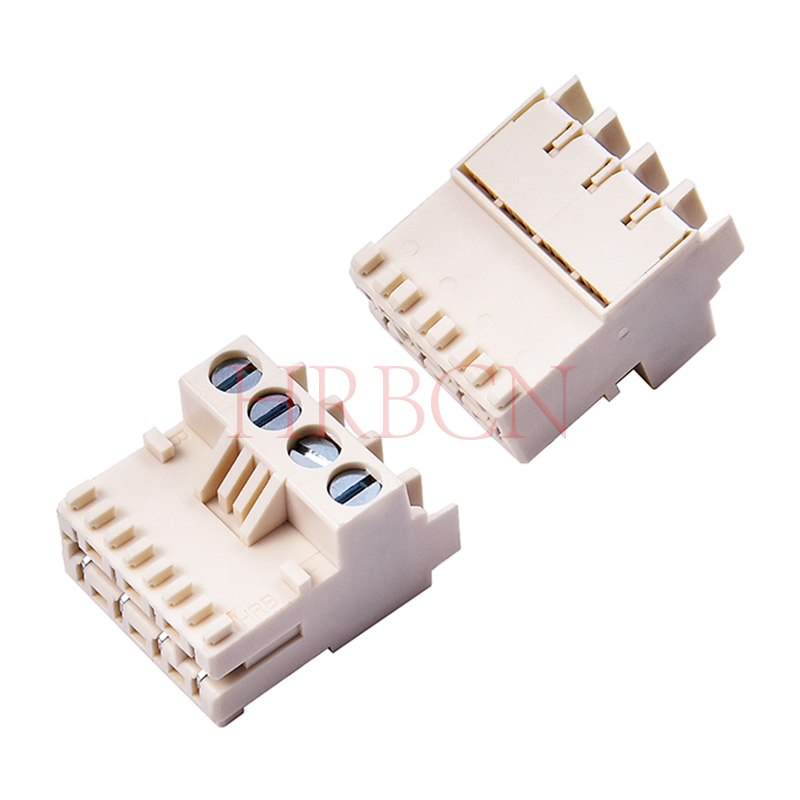
RAST 2.5 Connectors: Specifications and Ideal Use Cases
The 2.5mm pitch defines this category, offering a compact footprint for modern electronics. These components typically support voltage ratings up to 250V. Current limits generally range from 2A to 6A. The exact amperage depends heavily on the chosen wire gauge and the ambient temperature within the appliance enclosure. Engineers specify this pitch when routing low-power signals or driving small peripheral devices where physical space is at an absolute premium.
The reduced centerline provides a highly economical and space-saving solution. As appliances become smarter, control panels require higher pin counts to manage touchscreens, Wi-Fi modules, and complex sensor arrays. The 2.5mm spacing allows designers to pack more connections into a constrained PCB area. This miniaturization directly supports the transition toward sleek, low-profile appliance interfaces without sacrificing connection reliability. When routing 5V or 12V DC signals across a crowded logic board, the smaller footprint allows for tighter trace routing and smaller keep-out zones.
Typical applications focus on signal transmission and logic control. You will frequently find RAST 2.5 components routing data from temperature sensors, door switches, and water level monitors back to the main control unit. They also serve as the primary interconnect for LED lighting modules inside refrigerators and ovens. Internal logic board connections rely heavily on this standard to maintain organized, error-free wiring harnesses in tight spaces. The thin wires associated with this pitch (usually AWG 22 to 24) bend easily, allowing assembly workers to route harnesses through complex chassis corners without placing mechanical strain on the PCB header.
RAST 5.0 Connectors: Specifications and Ideal Use Cases
Stepping up to a 5.0mm pitch completely changes the power delivery profile. These components tolerate higher voltages, typically rated for 250V to 400V depending on the specific certification. The robust current capacity stands out as the primary feature, handling between 10A and 16A continuously. This high amperage capability requires thicker terminals, larger housing walls, and heavier wire gauges to safely conduct the energy without exceeding thermal limits.
The wider spacing delivers significant thermal and dielectric benefits. A 5.0mm pitch increases the creepage and clearance distances between adjacent pins. This physical separation improves dielectric strength and drastically reduces the risk of electrical arcing under high-voltage loads, satisfying strict IEC 60664-1 requirements. Furthermore, the larger physical footprint facilitates better thermal dissipation. When pushing 16A through a connection, the contacts generate heat. The wider housing acts as a passive heatsink, allowing this thermal energy to dissipate into the surrounding air, preventing the plastic from melting or degrading over time.
Engineers specify RAST 5.0 Connectors for heavy-duty loads. Verifiable use cases include driving washing machine drum motors, powering refrigerator compressors, and supplying current to 15A oven heating elements. They serve as the standard interface for primary AC mains connections entering the appliance. Any circuit requiring substantial power delivery mandates the 5.0mm pitch to ensure long-term safety and operational stability. Attempting to route these high-current loads through smaller pitches invites catastrophic failure.
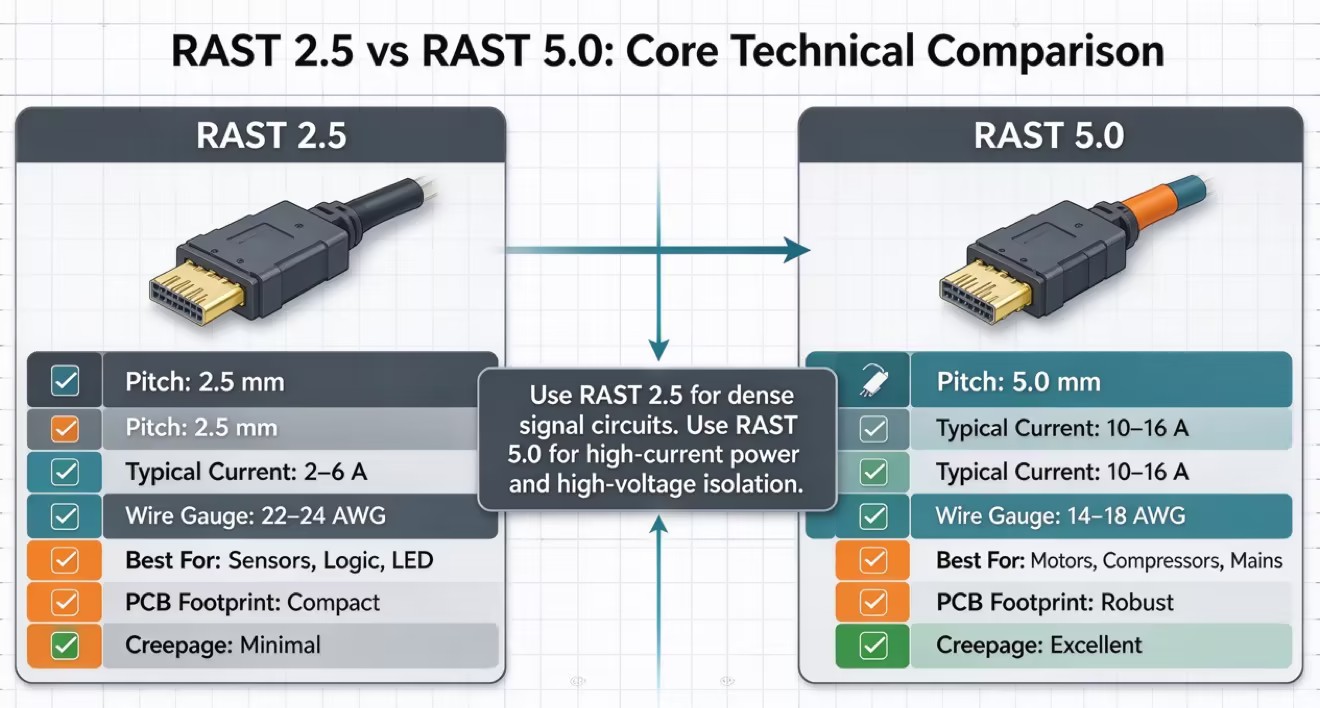
RAST 2.5 vs. RAST 5.0: Core Technical Differences
Pitch, Footprint, and PCB Real Estate
RAST 2.5 connectors feature a compact 2.5mm pitch, making them suitable for space-constrained PCBs and signal connections. RAST 5.0 connectors use a wider 5.0mm pitch, providing more space for larger terminals and potentially greater electrical clearance. Both support suitable PCB connection designs, but engineers must consider board thickness, contact plating, creepage distances, and layout requirements.
Current Rating and Power Handling
RAST 2.5 connectors are generally designed for lower-current signal and control applications, while RAST 5.0 connectors support higher-current connections such as motors, heaters, and power circuits. Actual current ratings depend on terminal design, wire size, contact resistance, and operating temperature. Engineers should verify manufacturer specifications and derating curves to prevent overheating and ensure reliable power delivery.
Insulation Displacement Contact (IDC) vs. Crimp Technologies
IDC termination simplifies wire harness assembly by connecting insulated wires without a separate stripping step, making it suitable for automated, high-volume production. Crimp termination provides an alternative for applications requiring specific wire sizes, mechanical retention, or assembly flexibility. Both RAST 2.5 and RAST 5.0 connector families may offer different termination options, depending on the manufacturer and product series.
Comparison of RAST Specifications and Mechanical Properties | Specification | RAST 2.5 | RAST 5.0 |
| Centerline Pitch | 2.5 mm | 5.0 mm |
| Max Current Rating | 2A - 6A | 10A - 16A |
| Typical Voltage | Up to 250V | 250V / 400V |
| Wire Gauge (AWG) | 22 - 24 AWG | 14 - 18 AWG |
| Primary Application | Sensors, Logic, LED | Motors, Compressors, Mains |
| Creepage Distance | Minimal (Requires careful routing) | Excellent (Inherent to pitch) |
| Harness Flexibility | High (Thin wire) | Low (Thick, rigid wire) |
How Engineers Pick the Correct RAST Connector
Application Success Criteria
Choosing the right RAST connector requires evaluating current requirements, PCB space, and application type. RAST 5.0 connectors are generally suited for higher-current applications such as motors, heaters, and power distribution, while RAST 2.5 connectors support compact, lower-current signal connections. Engineers can combine both types within appliances to balance electrical performance, space efficiency, and reliable connectivity.
Compliance and Safety Standards
RAST connectors must meet applicable electrical safety and material requirements, including UL 94 flammability ratings and relevant IEC 60335-1 requirements for household appliances. PA66 housings with suitable flame-retardant properties are commonly used. Glow-wire performance, temperature resistance, and electrical ratings should be verified against the connector manufacturer's specifications and application requirements.
Cost, Scalability, and Supply Chain Factors
RAST connector selection should consider component pricing, assembly efficiency, tooling compatibility, and supplier availability. Automated IDC termination can reduce production costs, but changing connector pitch may require additional equipment investment. Engineers should also verify housing dimensions, keying, and locking compatibility before selecting alternative suppliers to prevent assembly problems and ensure reliable connections.
Conclusion
The distinction between these two standards comes down to a strict division of labor. When comparing the two, RAST 5.0 provides superior thermal mass and dielectric spacing for heavy loads, remaining the non-negotiable standard for robust, high-current power delivery. Conversely, the 2.5mm pitch is the definitive choice for high-density signal routing, allowing engineers to pack complex logic into tight spaces without sacrificing reliability.
Your decision process should follow a strict hierarchy. First, evaluate the continuous current requirement and ambient temperature. Second, determine the necessary wire gauge to carry that current safely. Third, measure the available PCB footprint to see what physically fits. Finally, decide between a direct card-edge or an indirect header based on your board manufacturing capabilities.
To move forward with your design, take the following actions:
Request manufacturer derating curves to verify current capacity at your specific operating temperature.
Obtain Glow Wire Test (GWT) compliance certificates for the specific housing resin you intend to use.
Procure sample headers and receptacles to validate PCB layout, physical clearance, and harness routing paths.
Confirm that your harness assembly partner possesses the exact IDC or crimp tooling required for your chosen brand.
FAQ
Q: Can a RAST 2.5 connector be used for power applications?
A: Only for low-power applications up to 6A. It cannot replace the 5.0mm standard for main appliance power due to severe thermal and dielectric limitations. Pushing higher currents through a 2.5mm pitch causes overheating and potential melting.
Q: What does the "5.0" in RAST 5.0 Connectors stand for?
A: It indicates a 5.0 millimeter pitch. This measurement represents the exact distance between the center of one contact pin and the center of the adjacent pin. This wider spacing provides the necessary clearance for high-voltage and high-current applications.
Q: Are RAST connectors compatible across different manufacturers?
A: While the standard defines the pitch and keying methodology, proprietary locking mechanisms and housing tolerances vary. Cross-mating between different brands is highly discouraged and often physically impossible without forcing the connection, which compromises safety.
Q: How can I identify the manufacturer of a replacement RAST connector?
A: Look for molded identification symbols or logos on the plastic housing. Because proprietary keying prevents universal swapping, you must cross-reference these symbols and keying patterns with major manufacturers' catalogs to find an exact mechanical match.
Q: What is the difference between RAST 5 and RAST 5D?
A: The "D" denotes a Direct mating variation. This is a card-edge connector that plugs directly onto the exposed pads on the edge of the PCB. It eliminates the need for a separate soldered header, though the baseline pitch remains 5.0mm.
Q: Why choose IDC over crimping for a RAST connector?
A: IDC (Insulation Displacement Contact) allows for mass termination without stripping wire insulation. This significantly speeds up automated harness assembly and reduces manufacturing costs. It provides a reliable, gas-tight connection ideal for high-volume appliance production.


