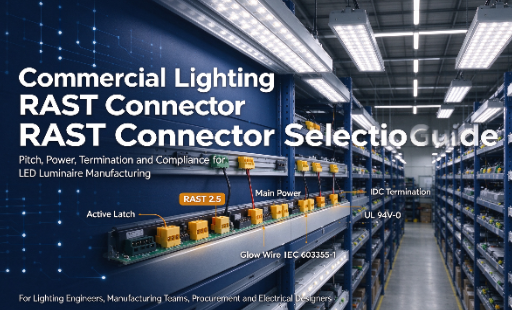
High-volume commercial lighting assembly demands absolute precision. A single mating error or thermal failure in a connector compromises an entire installation, leading to massive facility disruptions. Standard pin headers and consumer-grade LED strip connectors lack the retention force, polarization, and thermal resilience required for harsh commercial environments. When you install thousands of fixtures in a warehouse or retail space, you cannot rely on friction-fit components that vibrate loose over time. Engineers must balance the need for rapid, automated assembly with strict safety compliances, such as glow wire testing, and long-term mechanical reliability. Standardizing on a RAST (Raster Anschluss Steck Technik) connector system mitigates assembly errors and drastically reduces manual labor overhead on the production line. This guide breaks down the technical evaluation criteria for selecting RAST Connectors for LED and Commercial Lighting tailored to specific power, pitch, routing, and tooling requirements.
Key Takeaways
Pitch Dictates Power: RAST 2.5mm connectors are optimal for signal and low-power LED arrays, while RAST 5.0mm systems handle primary power delivery (up to 16A).
Termination Methodology: Insulation Displacement Contact (IDC) technology in RAST systems drastically reduces assembly time compared to traditional crimping, though it requires precise wire gauge matching.
Error Prevention: Built-in polarization and keying options prevent mismating during rapid assembly, a critical factor for reducing defect rates in commercial lighting manufacturing.
Compliance is Non-Negotiable: Commercial lighting connectors must meet specific dielectric and flammability standards, including UL/CSA ratings and IEC glow wire requirements.
The Role of RAST Connectors in Commercial Lighting Assembly
RAST connectors provide reliable electrical connections for commercial lighting systems, supporting secure assembly, vibration resistance, and efficient installation. Their standardized designs, locking mechanisms, and error-proofing features make them suitable for industrial and commercial lighting applications.
Key Requirements for Commercial Lighting Connectors
Requirement | Benefit |
Secure Locking | Prevents accidental disconnection |
Temperature Resistance | Supports operation under thermal cycling |
Current Capacity | Ensures reliable power delivery |
Compact Design | Saves space inside LED fixtures |
Automated Assembly | Improves production efficiency |
Mechanical Keying | Reduces incorrect connections |
Why RAST Connectors Are Suitable for Commercial Lighting
RAST connectors combine durable thermoplastic housings, secure mating designs, and standardized pitch configurations to support reliable lighting connections. They help reduce assembly errors and maintain stable electrical performance in warehouses, retail facilities, and industrial environments exposed to vibration and temperature changes.
RAST vs. Standard Consumer LED Connectors
Feature | RAST Connectors | Consumer LED Connectors |
Mechanical Retention | Available locking designs | Often friction-fit |
Vibration Resistance | Suitable options available | Varies by design |
Current Capacity | Series-dependent power ratings | Often intended for lighter loads |
Assembly | Supports automated termination | Often manual installation |
Error Prevention | Keying and polarization | Varies by product |
Applications in Commercial Lighting
RAST-based commercial lighting connectors can support LED drivers, lighting control boards, industrial high-bay fixtures, and modular lighting assemblies. Their compact structure and reliable mating features help simplify wiring, maintenance, and large-scale production.
Key Takeaway: RAST connectors offer a practical solution for commercial lighting manufacturers seeking secure connections, consistent assembly quality, and efficient production. Final selection should consider electrical ratings, locking design, environmental conditions, and fixture compatibility.
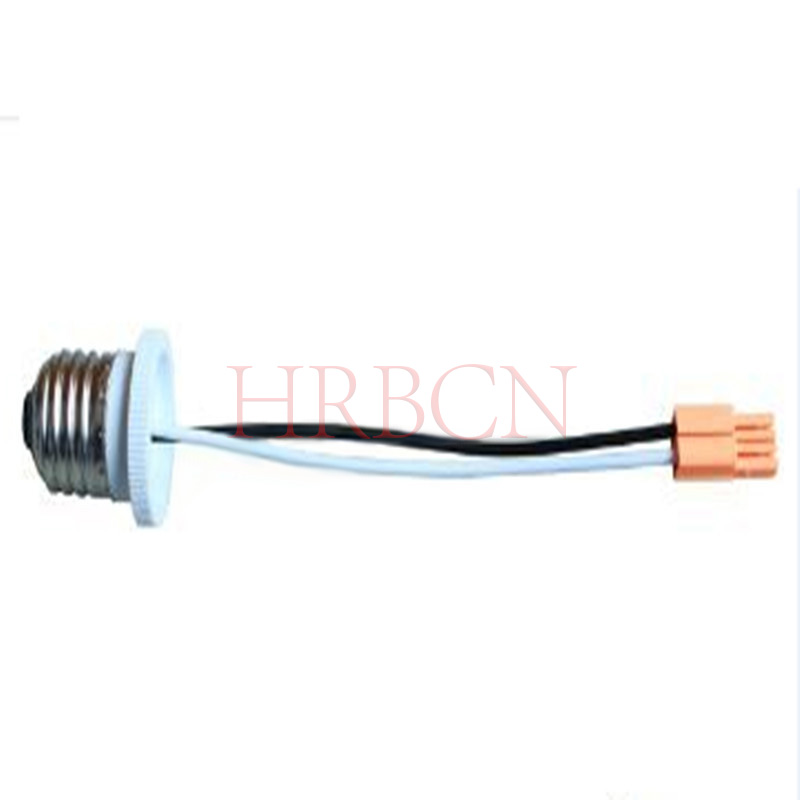
RAST 2.5 vs. RAST 5.0: Categorizing Pitch and Power Requirements
Selecting the correct pitch is the foundational step in specifying a RAST connector. The industry primarily relies on two standardized dimensions to match specific architectural lighting needs, balancing spatial constraints against power delivery requirements. Pitch refers to the exact center-to-center distance between the contact pins.
RAST 2.5mm Pitch Systems
RAST 2.5mm systems are engineered for high-density, low-power applications where board real estate is at a premium. These connectors are the optimal choice for signal routing, addressable LED data control, and low-power secondary circuits within complex luminaire designs. By replacing flimsy 3-pin consumer connectors with a RAST 2.5 header, manufacturers gain mechanical locking without sacrificing internal space. They easily fit inside narrow aluminum extrusions and low-profile troffers.
Current limitations for the 2.5mm pitch typically range between 2A and 4A, depending on the specific wire gauge and ambient temperature ratings. They generally accommodate wire sizes between 22 AWG and 24 AWG. This makes them unsuitable for primary power delivery in high-lumen fixtures but perfect for control signals. Space constraints dictate the use of the 2.5mm standard. They are ideal for low-profile LED luminaires, compact internal drivers, and tight architectural extrusions where every millimeter of clearance impacts the final aesthetic of the fixture.
RAST 5.0mm Pitch Systems
When the application demands robust power transmission, RAST 5.0mm pitch systems are the mandatory standard. These larger connectors are specifically designed for main power delivery, critical driver-to-board connections, and daisy-chaining commercial fixtures across long architectural runs. The increased 5.0mm distance between pins prevents electrical arcing at higher voltages, ensuring safe operation in high-demand circuits.
Standard RAST 5.0 systems comfortably deliver up to 10.0A and typically accept wire gauges from 14 AWG to 18 AWG. Modern commercial lighting often requires even greater capacity for extensive warehouse aisles or supermarket lighting grids. Specialized high-power variants push these limits further, delivering up to 16.0A depending on the manufacturer specifications and the applied wire gauge. This high-power capability allows engineers to design longer continuous lighting runs from a single power supply, reducing the total number of drivers required in a ceiling plenum.
Durability scales up with the 5.0mm footprint. The housings feature thicker thermoplastic walls, and the internal contacts are engineered to handle higher mechanical stress during mating cycles. This robust construction dissipates the thermal loads generated by 16A currents, preventing the plastic degradation that plagues inferior connectors over years of continuous operation.
| Specification | RAST 2.5mm System | RAST 5.0mm System |
| Pin Pitch | 2.5 millimeters | 5.0 millimeters |
| Maximum Current | 2A to 4A | 10A (Standard) up to 16A (High-Power) |
| Typical Wire Gauge | 22 AWG - 24 AWG | 14 AWG - 18 AWG |
| Primary Application | Signal routing, DMX control, low-power arrays | Main power delivery, driver-to-board, daisy-chaining |
| Housing Profile | Low-profile, fits narrow extrusions | Robust, thick-walled thermoplastic |
Technical Evaluation Dimensions for LED Lighting Connectors
Translating specific connector specifications into field reliability requires a rigorous technical evaluation. Engineers must map the physical features of LED lighting connectors directly to the desired operational outcomes, focusing on termination methods, locking security, routing flexibility, and material compliance.
Termination Types: IDC vs. Crimp
The method used to attach the wire to the connector contact fundamentally impacts both assembly speed and long-term reliability. The industry standardizes on two primary technologies: Insulation Displacement Contact (IDC) and traditional crimping.
Evaluate IDC technology for automated, high-speed termination. IDC machines press the unstripped wire directly into a specialized V-shaped contact blade. This blade slices through the insulation and grips the internal copper conductor, creating a highly reliable, gas-tight cold weld that resists oxidation. IDC drastically reduces manual labor, eliminates the need for wire stripping stations, and ensures uniform quality across thousands of units. The machine dictates the exact insertion depth, removing human error from the equation.
Evaluate crimp technology for specialized, lower-volume production runs or extreme vibration environments. Crimping requires stripping the wire and mechanically compressing a metal barrel around the exposed strands. While slower and more labor-intensive, crimped connections accommodate a wider variance in wire gauges and insulation thicknesses. This offers flexibility during prototyping, custom fixture assembly, or when dealing with unusually thick silicone wire jackets.
| Feature | IDC (Insulation Displacement Contact) | Crimp Termination |
| Assembly Speed | Extremely high; ideal for automated production lines. | Moderate to slow; requires manual or semi-auto wire stripping. |
| Connection Quality | Consistent gas-tight seal prevents long-term oxidation. | Highly secure, but heavily dependent on tool calibration. |
| Wire Gauge Flexibility | Strict tolerances; requires exact AWG and insulation OD match. | Accommodates a wider range of wire sizes and jacket types. |
| Best Use Case | High-volume commercial luminaire manufacturing. | Custom runs, prototyping, or specialized heavy-duty cables. |
Locking Mechanisms and Retention Force
Accidental disconnects during installation, routine maintenance, or due to ambient building vibrations cause unacceptable facility downtime. Analyze the necessity of active latches versus friction locks based on the installation environment. Friction locks rely solely on the tight fit between the plastic housing and the pins. Over years of thermal cycling, this plastic expands and contracts, eventually loosening the grip. Active latches require a physical mechanism to be depressed before the connector can be separated. This guarantees that the connection remains secure regardless of external mechanical stress, gravity, or accidental cable pulls during installation.
Physical Routing and Spatial Configurations
Commercial layouts frequently demand complex wire routing. RAST systems accommodate these spatial configurations by acting as robust alternatives to consumer L-shape and T-shape connectors. Through secure header configurations, right-angle pins, vertical headers, and flexible wire-to-board or wire-to-wire mating options, engineers route power around tight corners within aluminum extrusions without compromising the electrical connection. Flying leads allow for modular assembly, where different luminaire sections are snapped together on-site rather than hardwired in the factory.
Housing Materials and Compliance
Material science dictates commercial safety. Assess the importance of UL 94V-0 flammability ratings, which certify that the plastic housing will self-extinguish rapidly if exposed to an open flame. Furthermore, IEC 60335-1 glow wire compliance is mandatory for commercial lighting connectors installed in drop ceilings, plenums, or enclosed architectural spaces. During a glow wire test, a heated wire (typically 750°C or 850°C) is pressed against the connector housing. The plastic must not ignite, or if it does, it must extinguish within seconds without dropping flaming particles. These standards ensure that a localized short circuit will not ignite the surrounding fixture materials.
Performance and Value Influencing Factors
Choosing the right RAST connectors for commercial lighting requires balancing component costs, assembly efficiency, supply chain flexibility, and long-term reliability. Beyond initial pricing, manufacturers should consider total production and maintenance costs.
Automated Assembly Efficiency
RAST connectors with IDC termination support automated wire harness production, reducing manual labor, assembly time, and wiring errors. Consistent termination processes improve manufacturing efficiency and help maintain reliable electrical connections in high-volume commercial lighting production.
Standardization and Supply Chain Flexibility
Standardized RAST connector designs can simplify procurement and support alternative sourcing. However, keying, locking mechanisms, and housing dimensions may vary between manufacturers. Verifying compatibility and maintaining approved suppliers helps reduce supply disruptions and production delays.
Lifecycle Reliability and Maintenance Costs
Reliable RAST connectors help reduce connection failures, maintenance requirements, and equipment downtime. This is particularly important for high-bay lighting and other hard-to-reach installations where repairs are expensive. Proper electrical ratings, secure locking, and vibration resistance contribute to long-term performance.
Key Takeaway: RAST connector selection should focus on total lifecycle value, combining efficient automated assembly, reliable sourcing, and durable electrical connections rather than component price alone.
Conclusion
RAST connectors provide the necessary bridge between high-speed automated manufacturing and long-term field reliability for commercial lighting. By eliminating manual soldering, preventing mating errors through physical keying, and ensuring robust power delivery, these systems protect the integrity of large-scale architectural installations. Base the final selection on required amperage, termination capabilities, and environmental compliance.
Calculate maximum thermal and current loads for all fixture runs, applying an 80% derating factor to establish a safe baseline.
Request physical component samples to perform in-house mating, retention, and spatial routing tests within your actual luminaire extrusions.
Consult directly with connector manufacturers to verify automated tooling compatibility and wire gauge tolerances before finalizing the bill of materials.
Audit all selected components for UL 94V-0 and IEC glow wire compliance to ensure strict adherence to commercial building codes.
FAQ
Q: What does RAST stand for in electrical connectors?
A: RAST stands for Raster Anschluss Steck Technik, a German term translating to "Pitch Connection Plug Technology." It originated as an industry standard to unify and error-proof electrical connections in home appliances and was later adopted for commercial lighting due to its exceptional mechanical reliability and support for automated assembly.
Q: What is the difference between RAST 2.5 and RAST 5.0?
A: The numbers refer to the pin pitch, or the distance between the center of each contact, in millimeters. RAST 2.5mm is compact, handling lower currents (2A-4A) for signal routing. RAST 5.0mm is larger, designed for main power delivery, and handles significantly higher currents (up to 16A).
Q: Can RAST connectors be used for standard RGB or addressable LED strips?
A: While technically possible to replace 3-pin data or 4-pin RGB connections, RAST is typically reserved for commercial fixtures and drivers where mechanical locking, high current capacity, and extreme reliability are required. Standard, non-locking pin connectors remain more common for lightweight consumer LED strips.
Q: Why choose IDC over crimp termination for commercial lighting connectors?
A: Insulation Displacement Contact (IDC) technology allows for high-speed, automated wire termination without stripping insulation. It creates a consistent, gas-tight connection that prevents oxidation, drastically reducing manual labor hours and defect rates in high-volume commercial production environments.
Q: What is the maximum current rating for a RAST 5.0 connector?
A: Standard RAST 5.0 ratings typically hover around 10A. However, specialized high-power variants feature upgraded contacts and housings that safely support up to 16A, depending on the specific wire gauge and ambient operating temperatures within the fixture.
Q: Do RAST connectors meet glow wire testing standards?
A: Yes, most reputable RAST systems offer specific housing options engineered from advanced thermoplastics designed to meet IEC 60335-1 glow wire requirements. This certification ensures the connector will not ignite surrounding materials during a localized short circuit, maintaining commercial safety compliance.


